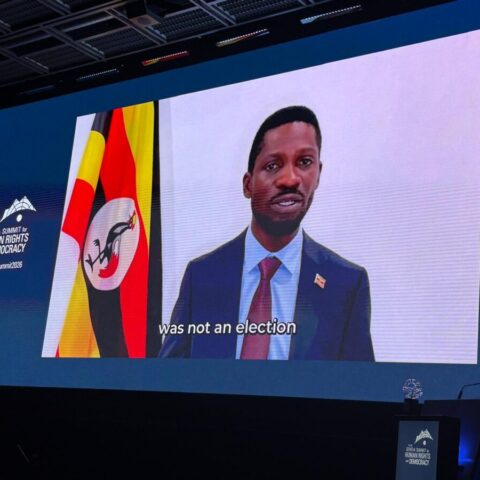
Pedro Urruchurtu Noselli, Venezuelan opposition advisor wanted on politically motivated charges who took refuge for more than 400 days inside the Argentine embassy in Caracas, addressed the 18th Annual Geneva Summit for Human Rights and Democracy on February 18, 2026.
Full Prepared Remarks:
On January 3, 2026, U.S. military forces seized Venezuelan narco-terrorist Nicolás Maduro and flew him to New York to face federal charges.
Broadcasters around the world asked: “Is this the beginning of the end for his authoritarian regime?”
And my answer is yes. I believe Venezuela will become a free and democratic country soon.
But that future did not begin with Maduro’s capture. It really began on July 28, 2024—when the people of Venezuela overwhelmingly voted against him. When 70% of Venezuelans said yes to María Corina Machado and Edmundo González, yes to democracy, and yes to freedom. It began even earlier, when María Corina won the primary election in 2023, with more than 93% of the votes.
I was part of those campaigns.
But I couldn’t celebrate the victory of July 28—because that night, I was locked inside the Argentine embassy in Caracas. I was a hostage.
I was 8 years old when Hugo Chávez became president. I remember my family went silent. They knew that Chávez would use democracy to destroy democracy.
But if Chávez achieved one thing, it’s that he got Venezuelans interested in politics. In 2007, in my first year at university, I watched millions of young Venezuelans mobilize against his constitutional referendum – and win. I was part of that. Politics became an act of self-defense against authoritarianism. And still.
I met María Corina Machado shortly after Chávez died in 2013 during the opposition campaign. Maduro stole that election. A few weeks later, María Corina called me after being a volunteer. She asked me to join her new political party, Vente Venezuela. I quit my job that day and started immediately.
Over the next ten years, I went from being the youngest and least experienced person in the room to Director of International Relations for María Corina Machado’s presidential campaign. It felt like a full-circle moment because when I met her 12 years ago, she held that role. Now I did.
As an International Coordinator, I traveled constantly. And every time I went to the airport, I knew they might arrest me. My colleagues used to say, “in a dictatorship, everyone has a number. One day, they’re gonna call your number.”
They called mine on December 6, 2023.
María Corina had just won the primary election.
I was in the middle of a press conference when my watch started vibrating: They’re coming for you. Run.
I got into a car with my colleagues -Claudia and Henry- and we sped to a nearby embassy. The ambassador accepted us and tried to put us at ease for a couple of hours. He asked how long we expected to stay. “This won’t take long,” I thought.
It was two weeks.
I had heard about this happening to other people. But it’s very different when you’re the main character in the story.
The first thing you learn is that THIS IS REAL. They could put you in jail if they wanted. It doesn’t matter what the truth is. You’ll never see an arrest warrant. All that matters is what they say… And they said I was a terrorist. A conspirator. And a traitor.
We stayed silent. And on December 20th, 2023, they released us in a prisoner exchange.
But that was the beginning. We were not free. They had canceled our passports and frozen our bank accounts. I had to report to a judge every two weeks—like so many others. That was just the beginning.
In January, the regime officially disqualified María Corina from running for president. There was no trial, no evidence, and no due process. It was a political ban, not a legal one. She was simply a big threat to Maduro. After that, the regime started targeting our campaign leaders, one by one. What was our crime? Managing a campaign and winning an election.
María Corina decided to keep fighting to defend the people’s mandate in the primaries
Then, on March 20, 2024, I was at the office when a new press conference announced that they were issuing another arrest warrant for me and ten of my colleagues. Two of them, Henry and Dignora, were abducted by the political police. The rest of us had to run.
I raced to the Argentine embassy. Throughout the afternoon, more arrived: Magallí, the Head of the Campaign, Claudia, the Communications Coordinator, Humberto, the Election Coordinator, Omar, the Political Coordinator, Fernando, the Alliances Advisor—and me. I looked around and thought, “Wow, we have everyone we need here. This is the new campaign office.”
Time was running out. María Corina could not be a candidate. Neither could Corina Yoris, her second attempt. Finally, Ambassador Edmundo González Urrutia stepped up to be on the ballot. We knew the opportunity that was in front of us.
They never expected us to keep campaigning from inside the embassy, while María Corina and Edmundo were traveling around the country.
But we did. It was a survival decision—the only possible one.
On election day, I remember standing on the embassy balcony overlooking Caracas. It was the first time I couldn’t vote in my own country.
That day, one of my missions was coordinating 64 international observers to visit the country. The regime deported every single one of them.
But we had nearly one million Venezuelan volunteers at polling stations around the country. They collected the tally sheets, scanned them, and uploaded them to the cloud. We made history.
That night, the regime declared Maduro the winner. But we knew the truth –we won by a landslide.
After that, everything changed. María Corina had to go into hiding. Edmundo González was forced into exile. The regime was ready to attack anyone connected to the campaign before, during, or after the election. People were sent to prison, forced into exile, or pushed into hiding.
In simple but painful words: State terrorism.
We were still stuck inside the Embassy! Over the next ten months, they did everything they could to break us and force us to surrender. They cut off our electricity and water completely. We spent five months without power, depending on a solar panel. Five months without running water. We drank water from the ambassador’s pool in the worst, unhealthy conditions. Without refrigeration, our food rotted. We rationed everything and sometimes ate only once a day.
And our neighbors were those who you never expected to have – the embassies of Russia and North Korea.
I remember gathering as a group to discuss possible scenarios. Maybe the regime would allow some of us to leave. But who would stay, and who would go?
We decided: no one leaves unless everyone leaves.
Then, in December, 9 months in, we realized that they had turned the neighboring house into a police surveillance post with masked men pointing assault rifles straight at us. This was no longer an embassy—it was a diplomatic prison. And I realized that dying was a real possibility.
Of course, I couldn’t sleep. I was terrified. We all were—knowing that at any minute, the regime could storm the embassy and take us to prison, or worse. But we decided to resist, and fear became our engine. We were free in mind and spirit.
In those final months, our only source of hope was the wild macaws—guacamayas—flying overhead in Caracas. They started coming down to visit us. They would sit on our shoulders and our arms. At first, they were a symbol of trust and freedom. And then, in May 2025, more than 400 days after we had arrived to that embassy, they felt like a signal from the universe that it was time to fly.
We had already planned to escape twice, with no success. But the regime made one massive error. They had cut the electricity to our building, and that meant their security cameras were off too. We figured out where the blind spots were and made our escape. They discovered it four days later.
After we were safe, we learned the regime had been building a tunnel underground to extract us—to make us disappear, or kill us.
But our escape proved that the regime is not perfect. They are divided. There are people inside Maduro’s system fighting for democracy—in secret. Without their help, and without the international support, we would not have escaped. I want to especially thank the U.S. government [—especially President Trump and Secretary Rubio—] for their leadership in our rescue, and all the courageous people that risked their lives to help us.
I don’t like to think about what would’ve happened if we stayed in that embassy much longer.
International law is supposed to protect people like us. It should not be a shield for governments to attack their own people. Diplomacy and international law are not useless, but their rules have not been effective in confronting criminal authoritarian regimes:
What do you tell survivors who are hiding in an embassy because they’re supposed to be protected — but no one is actually protecting them?
What happens when, before the eyes of the world, an embassy becomes a prison?
What do you tell the political prisoners’ families who are waiting for the international community to do something in the midst of despair?
Why do we keep arriving too late? What is diplomacy for if it is not used to stand up to injustice?
Today, I am forced into exile like many others. So I understand something very clearly: you are never truly free until your country is free. The threats against you are permanent, but you keep fighting for those who cannot do it. We have a mantra: No one is left behind.
That’s why we are working harder than ever. Maduro is gone—but Venezuela is not liberated yet. There are still nearly 800 political prisoners in jail and 30 million Venezuelans, inside and outside the country, getting ready for the final day of liberation. As I was writing this speech, two colleagues I mentioned earlier, Henry and Dignora, were released after nearly two years in prison.
Today, I want to take a moment to recognize the brave Venezuelan people, to recognize my colleagues, and to recognize every exile and political prisoner who has been released—and those who are still in jail, as well as their families, especially those who are today on hunger strike demanding freedom.
Today, I call for the total, immediate, and unconditional release of all political prisoners civilian and military, because there is no transition with repression. I want to be clear about this idea – there is no transition with repression.
It is the brave Venezuelan people who give me hope for the future of Venezuela. I trust them. We trust each other. And that is why I will keep fighting until the very end. Asta el final. Venezuela a la libre
Thank you.
18th Annual Geneva Summit for Human Rights and Democracy, U.N. Opening, Tuesday, February 17, 2026
Key Quote:
“International law is supposed to protect people like us. It should not be a shield for regimes to attack their own people. Diplomacy and international law are not useless, but their rules have not been effective in confronting criminal authoritarian regimes.”