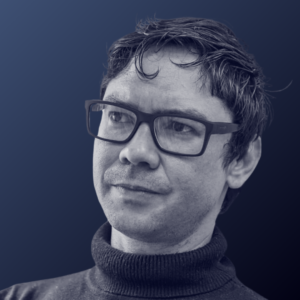
Yunior García Aguilera, Cuban playwright and democracy activist, addressed the 18th Annual Geneva Summit for Human Rights and Democracy on February 18, 2026.
Full Prepared Remarks:
My name is Yunior.
Just junior.
I was born in Cuba in 1982. The generation before mine had names inspired by Soviet culture. Cosmonauts were all the rage: Yuri, Alexei, even Laika.
When our parents got tired of that, they started giving us the names they heard in American movies.
I was lucky: they named me Yunior.
But I had friends named Danger or Usnavi, like the United States Navy.
I did theater in Cuba for over twenty years. At first, they were harmless comedies. But when you try to seriously represent the reality of a country like Cuba, it’s impossible to avoid the plays becoming absurdist or political theater. And I ended up doing political theater.
I think my parents should have named me Danger.
My teachers lived in panic with each of my works, but they taught me a trick: as long as my characters spoke and not me, I had an alibi.
As long as it all sounded like a metaphor or allegory, I was —more or less— safe.
That’s how I survived for a while. In a work calledBlood, they mentioned political prisoners. In another, calledSemen I criticized indoctrination in schools. In Passport, I was talking about the exodus of young people fleeing the country.
Playwrights of my generation discovered that the officials in charge of censorship were only trained to detect metaphors. But when plays directly attacked the regime, they were somewhat lost. They wondered, “What did they mean?”
Then came my most political work of all, Jacuzzi. Where it wasn’t a character who declared himself against the Revolution, it was myself. The character wasn’t called José or Pedro. He was called Yunior.
I crossed the red line, and I crossed it for good. Until then, I was just an inconvenient writer. Watched, yes. With State Security breathing down my neck, yes. But until then, it was something they thought they could control, because theater is something that happens in small, enclosed spaces.
On November 27, 2020, artists took to the streets. We stood in front of the Ministry of Culture in Havana. It was something that had never happened before in Cuba. We demanded the release of other detained young artists—the young people from the San Isidro Movement.
We demand an end to censorship, an end to repression, and the start of a peaceful dialogue to find a democratic and sovereign solution to an unpopular and exhausted regime.
That day was beautiful. Beautifully naive.
We truly believed that we could change the country where we were born with songs and poems.
The regime treated us as if we were worse than a pandemic.
I was accused of being a CIA agent.
The Cuban regime is not usually very original.
Six months later, on July 11, 2021, hundreds of thousands of Cubans took to the streets to protest.
They sang Homeland and Life, rather Homeland or Death, the official slogan.
The country’s president, Miguel Díaz-Canel, gave an order to fight against his own people.
They beat us up.
A young man died: he was shot in the back by armed police.
My friends and I were thrown into a garbage truck and taken to jail.
The cameras of the EFE news agency recorded that moment.
That’s why we were released the next day, but hundreds of young people remained imprisoned. Some received sentences of up to twenty years in prison.
Upon my release from prison, I created a platform on Facebook: Archipelago.
We wanted to show that Cuba is more than just an island: that it is plural, diverse, and that we all have the right to dream about our future.
We ask for permission to march peacefully, with white flowers.
But they never allowed it.
My house was surrounded.
They cut off my phone and internet.
They beheaded pigeons in front of my door.
They blocked the windows with flags.
They threatened my wife and my mother-in-law.
And they assured me a 27-year prison sentence.
I had to leave the country. I came to Spain with my wife.
I was not the Messiah that many expected.
I was more like Jonah… and I was swallowed by a big fish called exile.
The Cuban regime tries to make us believe that when we leave, we disappear.
My son stayed in Cuba. My only son.
I haven’t been able to see him since I left.
He used to be one and a half meters tall; now he’s over six feet tall and already has the shadow of a mustache.
My father died a year ago, inside Cuba.
I couldn’t say goodbye either.
And I’m not the only one this has happened to.
I didn’t come here to play the victim.
I’ve been lucky. I’m alive and I’m free.
That’s why I prefer to talk about those who remain inside Cuba, trapped in the belly of a much darker and more bitter fish.
A few days ago, two young men from Holguín —the city where I was born— were arrested.
They are also accused of working for the CIA.
Is there anyone from the CIA in this room?
Because they owe us a lot of money.
When all of us in Cuba who have been accused of working for the CIA receive our pay, Cuba’s GDP will be larger than Switzerland’s.
These young men are named Ernesto and Kamil.
The crime was having a YouTube channel calledEl4tico.
They spoke of freedom and democracy. Two words considered subversive in Cuba.
They also had more followers than the country’s president.
Although that’s not a merit.
Anyone has more followers than Miguel Díaz-Canel, who came to the “presidency” with a single vote: the only one that matters in Cuba, that of Raúl Castro.
The regime prefers to speak of two other words:sovereignty and anti-imperialism. They repeat them a lot.
Interestingly, those words did not appear in 1968, when Soviet tanks crushed the Prague Spring.
They also did not appear when Russia invaded Ukraine in 2022.
Cuba is the Olympic champion in moral gymnastics:
Sometimes invading is wrong;
Other times it is a “special military operation.”
Today there is a lot of talk about Cuba.
The president of Mexico says she fears a humanitarian crisis.
Now?
Were the last five years normal?
In Cuba, three times as many people die each year as in the Dominican Republic, a country of similar size.
More than one and a half million people have had to flee the island since 2021.
The regime says they are not fleeing because of political problems, but there is nothing more political than hunger.
Cuba is not on the verge of a humanitarian crisis.
Cuba is experiencing a chronic humanitarian crisis.
We are often told:
“I hope you can get through this on your own.”
But we are hostages.
And the hostages don’t free themselves.
That only happens in the movies.
I am not here to ask for invasions.
I have never held a weapon.
My son is inside Cuba and I fear for him.
But the international community must understand that inaction also kills.
Looking the other way is taking sides.
It’s time to support the people in Cuba, not the government. And the people are crying out for change.
When I talk to my friends in Cuba, many tell me:
—We are afraid, yes… afraid that everything will stay the same.
And I think the worst thing that could happen to us
It’s that nothing happens.
Because if that dictatorship remains in power for three, four, five more years, perhaps there will be nothing left to save.
And when someone asks, in another forum like this one, who did something, silence will also count as an answer.