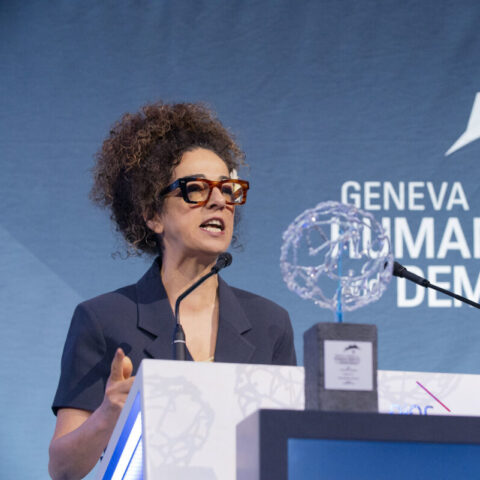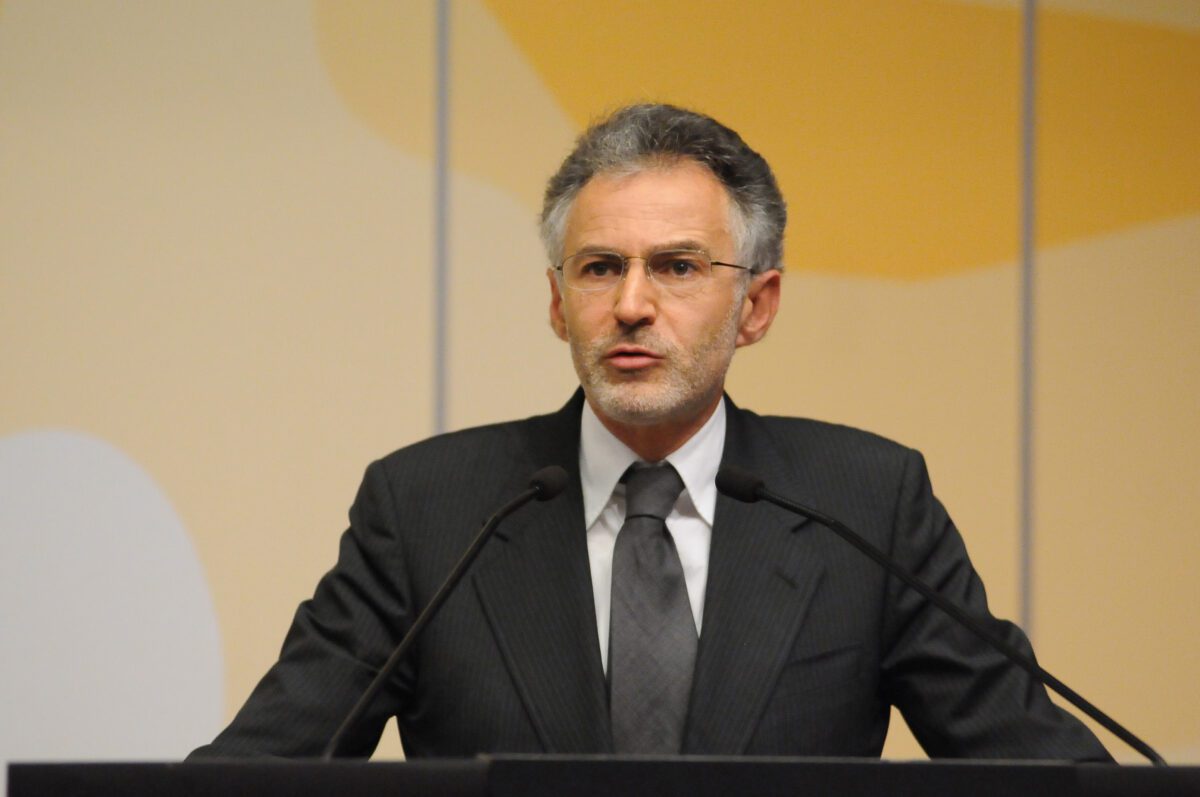
Francois Zimeray, international lawyer who has served as Ambassador of France to the UN Human Rights Council, addresses the 1st Annual Geneva Summit for Human Rights and Democracy – see below for full prepared remarks.
Full remarks
Nazanin Afshin-Jam: I’d like to present to you ambassador Francois Zimeray. He’s the Ambassador of France for human rights. He was a mayor in France at the age of 27. And at 37, became a member of the European Parliament, the youngest member of the Socialist delegation. He is a longtime human rights activist for victims in Darfur, Laos, the Congo, and for the cause of Middle East peace. I’d like to call him up here so he can say his final remarks and then we’ll be hearing from another Ambassador and then we’re all done.
Francois Zimeray: Excellencies, ladies and gentlemen. I would like to say first and foremost that it’s a real privilege to be able to speak to you this evening at the end of a day which I know has been extremely rich and very interesting. We can all feel it, more or less clearly. We are not experiencing a moment which is the usual sort of moment because we are now on the eve of a day which might be historical. This evening I would have liked to give you the definitive position of France but unfortunately we’ll have to wait a little bit because the French position has not yet been finally decided on. There are still consultations going on. After all, this is quite normal in view of what is at stake and in view of how complex the situation is that we are facing. Complexity is really the key word. We’re in a world which requires simplicity, which rejects complexity, which is calling for obviousness. And yet I would like to point to our approach and our view of this complexity.
I believe in symbols and I am not unaffected by the fact. I read this in the train, that in a few days from now, at the very time when the Durban Review cConference will come to an end, the court case of the presumed murderer of Ilan Halimi will start. Those of you who have not followed this case might want a few explanations. Ilan Halimi was a young French Jew or Jewish Frenchman. What he wanted was to simply live an ordinary life, happy in his country. Unfortunately on his way he came across someone who was from Africa, who lived in France, in a less than pleasant neighborhood, who felt discriminated against. And this person, coming from Africa, had got it into his head that there was one main cause which was responsible for his unhappiness, namely the Jews.
A few years ago I saw some of you here already. I spoke of the Durbanization of people’s views. There were some ideas which were not in the file text of the conference but now eight years later everything is somehow amalgamated. All the ideas coming from this Durban One Conference amalgamated with all the cries of death to the Jews, which were heard outside of the conference. The conference was supposed to deal with all the victims of discrimination and racism, and these people found a scapegoat for their suffering and for their difficulties. The scapegoat was Israel, it was the Jewish people, and it in fact the word laboratory of hatred was mentioned.
Now the official conference and the forum of the NGOs form one single entity even if, historically speaking, there are two different meetings, the speeches are not the same, and the attitudes are different. But nevertheless one sees them as one whole. Today very clearly, the images of Durban One are coming back, are reflected in the waters of Lake Geneva, and we can feel this intense emotion that was generated by Durban One.
This was covered up by something which happened only a few hours or a few days afterwards, after Durban One, namely the assassination of Commander Masood and then the 11th of September. So now you have the feeling that the words preceded the actions. This anti-Jewish and anti-Western discourse really gave courage to the terrorists of the 11th of September. Of course there’s no real link. But the image that lingers with us is that there is a link. So we are fully aware of the moral dimension, which is traumatic. The moral dimension of Durban One, and this is how we are going to the so-called follow-up review conference.
France, through the voice of first, the Prime Minister, through the Secretary of State, and the Foreign Minister, has contributed for Europe to draw up some very, very clear red lines and you mentioned these today. These red lines were first and foremost the choice of the conference venue. We did not want this conference to be held in a country where fundamental rights are not guaranteed, and where one could say anything one wanted out in the streets and where, again, there could be such a form of hatred as there was at Durban One. The red line and we’ve had this distinction because we envisaged Durban again as a venue, possibly Tripoli, and we decided that it would be Geneva. Another red line, not reopen the conference agenda and reintroduce this notion of blasphemy or defamation of religion, which I call blasphemy. Not to have this on the international agenda, the international legal agenda. And we’ve had the satisfaction of not seeing this. Third red line, we refuse the stigmatization of Israel. Not just because it means anti-Semitism and anti-Zionism, but because the world has a right to have a reflection of the real violators of human rights shown to it, and not some kind of obsessional fantasy, which uses the Jews and Israel as a scapegoat in order to cover up the real and very serious violations of human rights throughout the world. At least this has also been a point where we’ve got satisfaction, at least from the formal point of view. I know better than many, and those who have followed my struggle will know that when I look at a text I know very well the weaknesses and shortcomings of the text. I cannot allow people to say that formally this text does not respect the red lines that we set out. This text is just like all the human rights struggles, it’s not satisfactory, it is not complete. And when we say incomplete, when we look at the situation in the world today, I think of something which happened recently, and I have to tell you today because it’s something which upset me very greatly a few weeks ago.
The triumphal welcome which was given to the Sudanese President Bashir, this was extremely shocking after the condemnation of the international court. There was a silence around him. And a French author said “those who are not shocked by what is shocking are more shocking than what should shock them.” I myself was profoundly shocked because if there is a success, a progress to be seen in international human rights in the last 50 or 60 years, it is this international body of law which tries to deal with dictators. But it’s still very fragile. And people say, “human rights are just words, attitudes.” No! Human rights are not attitudes and not words. We’re not talking about moralizing. Human rights are laws, it’s legislation; it either exists or doesn’t exist. It is implemented or not implemented and the work of the international bodies is to build up this state of law, this body of law, and to make it available to the governments.
First of all, the international legislations are put together by international bodies and then brought to the five continents by NGOs, by all kinds of organizations. Sometimes the legislation is a reality. In the Hague, behind bars, there are people nowadays who have been arrested for having committed war crimes for having hired child soldiers. This is a reality. This reality didn’t just come down from heaven, it’s the fruit of this multilateral diplomacy in the field of human rights. This reality is based on treaties. Treaties which were negotiated, imagined, amended, and adopted, and finally implemented by 139 states. 139 out of 192 is not all of them. Of course, out of the 139, most of them are not democracies, some of them are not very respectable. But these countries nevertheless have signed.
Now through this example I would like to point out that the world of human rights is also being built with the others, with the assistance of the others. What would be the worth of an international court of law if it had only been built by the European Union and the United States and a few others? It would not have any power at all. It would not be able to bring to life this idea of universality, which we celebrated last year on the occasion of the 60th anniversary of the Universal Declaration. France has always been at the heart of this combat. We are attachable to multilateralism. As I speak I do not know yet what the position of our government will be, whether we will participate or not. And I say that perhaps this is a question of secondary importance. It is what you are saying; it’s the work you’re doing that is important. And, if the text, even if it was unsatisfactory, even if it is not a good text, participation is important. A president who is not known for his anti-racism, who is anti-Semitic, is anti-Zionist, this president in the last few years.
Our fight has been in favor of international Court of Human Rights, Convention Against Torture. A convert convention against disappearances. We fought for 20 years with Argentina; it has been adopted now. In the future we will have the struggle against homophobia. Perhaps there will be a resolution at the United Nations in the future. And there will be a struggle for the abolition, the universal abolition, of the death sentence. Now two-thirds of the countries have already abolished it. There was a struggle for equality between men and women. So for us, the struggle does not stop at this conference, it will not come to an end and it’s not an easy decision.
[Applause]
A few weeks ago I was in Burundi with the Secretary of State for Human Rights. And we have been able to look at the reality. I’m not sure whether at the Durban Review Conference it will be mentioned. But I will say something about it. I could have chosen any of 50 other examples. The albinos, which are discriminated against because of their color of skin and also because of their illnesses because in their poor country they all get skin cancer now for a few months. For the last few months they have become the focus of a strange belief which says that the flesh of an albino brings luck and therefore they cut people’s legs off. They kidnap albinos and children told me that they were horrified to know that one of their albino friends had both his legs cut off by his father in order to sell them. There are legal tools that we do not have, legal instruments that we do not have, to combat this kind of traffic, which always goes across borders. And so we must not abandon the idea of multilateral dialogue.
We have now entered into a world which is full of danger. The only certainty we have is that tomorrow will not be the same as today. There will be new threats, there will be new anxieties, there will be new concerns. In the past these were not very important, such as, for example, climate change. Nowadays it is a universal concern. I’m thinking of the food crisis, the crisis of water, and the financial economic crisis. In fact, it’s not really a financial crisis, it’s economic, it’s social, it’s political, but it’s certainly a crisis of our civilization. In this new world full of threats, I think more than ever we will need places where people can come together to talk, to have a dialogue, and to try and find solutions. That is why in view of this complexity, in view of all these difficulties, for us there is no simple answer because we are part and parcel of this system.