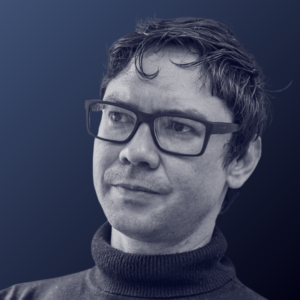
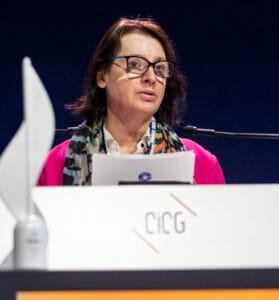
Survivor and activist fighting to end Female Genital Mutilation, Marie-Claire Kakpotia, addresses the 15th Annual Geneva Summit for Human Rights and Democracy – see below for her remarks.
Full Remarks
I am very honored to speak here today and I want to thank the Geneva Summit for giving me the opportunity to break the taboo about a horrible practice.
When I was nine years old, I was on vacation with my father’s family in Côte d’Ivoire when my aunt told me we had been invited to a party. I was happy to go, but when we got inside, it wasn’t a party. They put me in a line of young girls, some just three years old. One by one, they were invited inside, and a few minutes later, they came out hysterically crying. What was happening? The other girls didn’t know.
Finally, it was my turn. I walked inside, and four women seized me immediately. They slammed me to the ground, yanked off my pants and my underwear, took out a knife, and cut deep into my vagina. I couldn’t stop crying. It was the worst pain I’d ever felt in my life. Tears streamed down my face and blood flowed from me.
At the time, I didn’t know what “Female Genital Mutilation” was. I didn’t know that the part of me they had cut out was my clitoris and how that would impact my life as a mature woman.
My mutilation was followed by silence. I didn’t tell my mother. Months later, my grandmother told her – she was happy and confident that I had been mutilated. My grandmother told her that I would be a “good wife” for my future husband.
Today, I live in France, and I run an organization called Les Orchidées Rouges, in English “The Red Orchids.” And the one thing I hear again and again is – “Oh, that’s just an African problem. An outdated tribal practice. That doesn’t happen here in Europe.” But I’m here to tell you – that you are wrong.
FGM [Female Genital Mutilation] is a problem worldwide. 200 million women and girls have received FGM around the world. In Asian countries like India, Thailand, Indonesia, or Pakistan. In African countries like Senegal, Côte d’Ivoire, Guinea, Somalia, and Ethiopia. In Arab states like Iraq, Yemen, and Oman. In Russia. And in diaspora communities worldwide. So, if you think your country isn’t affected by FGM, you are wrong.
In France, where I live, FGM is illegal, and anyone caught performing the procedure faces ten years imprisonment and a 150,000 euro fine. But it doesn’t matter that it’s illegal. The practice happens behind closed doors, in secret, often on holiday. I have met countless European women whose parents took them abroad to visit relatives, and like me, they returned home, traumatized, with blood-soaked underwear.
You might hear the practice called “female circumcision,” but don’t be deceived. FGM is not the equivalent of cutting off the foreskin, it would be as if we cut off a man’s entire penis. In fact, some girls aren’t just mutilated. They are sewn shut. And then it is the duty of the husband to open the vagina when they are married.
It is a brutal, evil form of torture. And it has long-lasting consequences into adulthood.
When I was 22 years old, I met an Italian man, and we decided to have sex. As soon as he saw me naked, he stopped me. “Where is your clitoris?” he said. “You cannot be a real woman if you don’t have a clitoris.” He couldn’t get over it. And I couldn’t get over that feeling of being half a woman. Of being inferior, undesirable, and broken. It haunted me for years.
Then, in 2016 I read a story in a magazine about a girl who like me had undergone surgery to repair her clitoris. On December 7, 2016, I had genital reconstructive surgery. I call that day my second birthday because when I woke up from the anesthesia, I was a different woman, smiling and serene.
That same year, I founded Les Orchidées Rouges to fight for the eradication of Female Genital Mutilation, forced and early marriage, and other types of gender-based violence. Since 2020, we have offered free therapy, treatment, and support to 650 survivors of FGM at our institutes in France and Côte d’Ivoire. By reconstructing themselves physically, psychologically, and sexually, survivors gain the self-confidence to follow their personal and professional dreams. And the same is true for me. Today, I’m with a loving man, I’m the mom to an incredible son, and I’ve never been more confident in myself and my body.
Through my organization, I have met hundreds of survivors, their families, and even cutters. And I have realized that the most important thing you can do right now is to spread awareness about the horrors of Female Genital Mutilation. Tell people that it is not just a West African problem. That there are 500,000 survivors in Europe alone. That every minute, six little girls are mutilated. That among FGM victims, one in four dies immediately or later on in life. And that it might be a long-standing cultural practice, but we cannot stand for it any longer. People say, “It’s been done since the time of the Pharaohs’ time; who are we to say that our ancestors were wrong?” I say our ancestors were human, just like us. We can honor our ancestors and choose a more humane path for ourselves, our families, and our children.
No woman or child deserves to go through what I went through. Female Genital Mutilation must stop now.
Thank you.
15th Annual Geneva Summit for Human Rights and Democracy, U.N. Opening, Tuesday, May 16, 2023