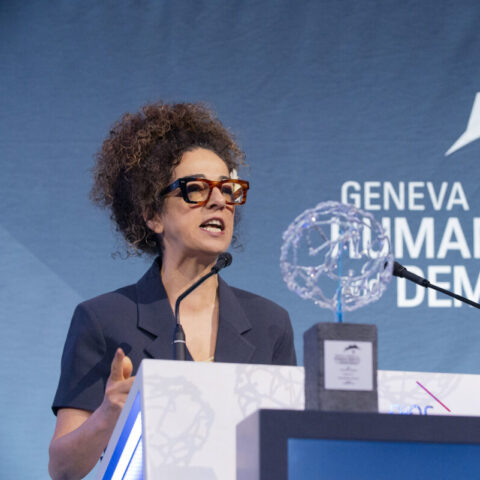
Manuel Valls, ancien premier ministre de la France, s’adresse au 16e Sommet de Genève pour les droits de l’homme et la démocratie – voir son discours complet ci-dessous:
Merci cher Hillel Neuer.
Mesdames et messieurs, je mesure le privilège et l’honneur de prononcer à mon tour le discours d’ouverture de votre 16ᵉ Sommet de Genève pour les droits de l’homme.
Une forme de vertige me saisit, et nous saisit tous, face aux menaces et aux défis auxquels le monde est aujourd’hui confronté.
Pour le mesurer, il suffit de se dire que le réchauffement climatique, ou une confrontation nucléaire désormais agitée régulièrement par Vladimir Poutine peuvent détruire la planète et l’humanité.
Il ne s’agit pas de se faire peur, mais d’être pleinement lucide. Les migrations, les millions de déplacés et de réfugiés fuyant la guerre, la faim, le réchauffement climatique, les effets des crises financières ou de la pandémie de la covid-19 déstabilisent, fracturent de nombreuses régions dans le monde.
Les vieilles démocraties sont déstabilisées par le désenchantement, les vagues populistes et identitaires, le terrorisme, ou les ravages de l’antisémitisme, c’est-à-dire la haine des Juifs et d’Israël, notamment depuis le 7 octobre dernier.
La guerre n’a jamais quitté le Proche-Orient ni l’Afrique, mais elle est de nouveau présente en Europe, en Ukraine, et elle peut s’étendre sur le continent qui se croyait à l’abri depuis 75 ans dans le confort et la douceur de la démocratie et de la paix.
Nous sommes entrés incontestablement dans un monde âpre, plus dangereux et plus violent. La part tragique de l’histoire s’invite de nouveau, et nous sommes très loin de la prédiction de Francis Fukuyama de 1990 après la chute du mur de Berlin sur le triomphe progressif, croyait-il, du modèle de la démocratie libérale et de l’état de droit. Pire, ce modèle est ouvertement remis en cause par les dictatures. Évidemment, je pense en premier lieu, par la Russie et par la Chine. Mais aussi, dans les démocraties, par les tenants de pouvoir autoritaire et de ce qu’on appelle des démocraties illibérales.
Et pourtant, je reste plus que jamais convaincu des principes de la Révolution française de 1789 qui ont illuminés le monde, de la Déclaration des droits de l’homme et du citoyen, et notamment celle de 1948 qui doit tant à René Cassin.
Ces principes devraient inspirer plus que jamais les Nations Unies, notamment ici à Genève. La démocratie, l’état de droit, la séparation des pouvoirs, le droit de vote, le respect des personnes et des minorités, de l’altérité, l’égalité entre les hommes et les femmes, la possibilité de croire ou de ne pas croire, la liberté de conscience, la liberté de la presse: tout cela forme un modèle, et c’est uniquement dans ce modèle, certes imparfait mais perfectible, que nous pouvons vivre et respirer. C’est pour ce modèle que se battent par exemple aujourd’hui les Ukrainiens avec un courage immense. Ils défendent leur pays attaqué, violé, par l’intervention Russe. Ils défendent les valeurs de l’Europe, ils défendent la démocratie, ils défendent les valeurs universelles.
Et c’est pour cela que vous êtes ici, ces valeurs que je viens d’évoquer.
Nous devons, nous européens, la communauté internationale, dans son ensemble, les aider concrètement à gagner cette guerre.
Je le dis ici devant des personnes dont nous allons entendre les témoignages poignants et qui ont subi physiquement et moralement les conséquences de leur engagement pour la démocratie, pour la liberté d’expression. Je veux saluer leur combat, votre combat. La cause de ces dissidents courageux qui luttent contre la dictature, l’oppression, qui luttent pour la défense des droits de l’homme.
Lors du dernier sommet, Evgenia Kara-Murza prononça ce même discours d’ouverture. Son mari Vladimir est toujours dans une prison russe, ce journaliste et cet écrivain qui vient de recevoir le fameux Prix Pulitzer et c’est une manière de rappeler quel est son combat. Mais je n’oublie pas qu’Alexey Navalny est mort dans les conditions que vous savez.
Ce mot dissident, que je viens de prononcer, était au cœur de mon engagement politique il y a bien longtemps. Je ne pensais pas qu’après avoir, très jeune, lutté pour la libération des dissidents du système soviétique, je me trouverai de nouveau, 40 ans après, avoir prononcé ce mot et à me battre pour ceux qui sont dans les geôles de Vladimir Poutine.
Cela démontre l’ampleur du combat qui est le nôtre face à la menace des dictatures comme la Chine, la Russie, l’Iran, alliés, en plus, sur la plupart des sujets qui concernent le monde pour remettre en cause l’ordre mondial et pour imposer le leur. Je n’oublie pas leurs alliés, comme le Bélarus, le Zimbabwe, ou Cuba, véritable leader de cet axe en Amérique centrale et en Amérique latine, avec le Venezuela ou le Nicaragua. La Russie cherche partout à déstabiliser les démocraties en menant une guerre directe contre l’occident, comme au Sahel, en pillant d’ailleurs ces pays et leurs ressources ou en menant une guerre hybride comme en Europe ou en Amérique du Nord à travers les réseaux sociaux, intervenant dans les processus électoraux; à travers des algorithmes; à travers le rôle de TikTok, avec des fake news, avec la pénétration intense des systèmes de communications. Tout est fait pour provoquer désordre et chaos.
Votre sommet, mesdames et messieurs, se déroule en face du conseil des droits de l’homme des Nations unies. Malheureusement, 60% des membres de cet organisme sont des non-démocraties, si je puis dire, des dictatures, comme Cuba, le Qatar, la Chine, le Soudan, l’Érythrée, l’Algérie, le Vietnam, le Kazakhstan. La Russie et le Venezuela ont souvent été membres par le passé.
J’ai gouverné, je sais que c’est difficile, il faut toujours qu’il y ait des relations diplomatiques. Mais là, nous parlons de l’essentiel, c’est-à-dire des droits de l’homme, du respect des êtres humains. Comment s’étonner que ces pays cherchent à détricoter alors les principes de l’état droit et de la démocratie, et ainsi de l’ordre international issu de la Deuxième Guerre mondiale ?
Comment s’étonner alors que ces pays cherchent à remettre en cause les droits de l’homme, les droits des femmes, ou des personnes LGBTI ?
Ils portent, ces pays, un discours, une certaine vision de la société, réactionnaire, conservatrice. Ils cherchent à imposer ces idées au reste du monde. Comment accepter, par exemple, la place de l’Iran, qui a présidé il y a peu le forum social annuel du Conseil des droits de l’homme ? On pourrait parler, si le sujet n’était pas sérieux, d’une mauvaise plaisanterie. Et qui réprime violemment sa population, sa jeunesse, les femmes, et toute expression de liberté et de culture, comme celle du rappeur Toomaj Salehi, condamné à mort il y a quelques jours par une justice unique aux ordres du régime des mollahs.
Je pense aussi à la persécution des minorités musulmanes et plus particulièrement, aux Ouïghours en Chine. Alors que le président Xi Jinping vient de faire une visite dans plusieurs pays d’Europe, dont la France et heureusement, il y a eu, comme pour ce qui concerne la situation au Tibet, des militants courageux pour rappeler ce qui se passait en Chine.
Les femmes, qui sont souvent les premières victimes de la répression et d’une véritable régression de leurs droits. Je pense au droit à l’avortement qui est mis en cause dans certains pays d’Europe ou en Amérique du Nord, en Amérique du Sud. Je pense aux viols de masse commis le 7 octobre en Israël, sans soulever, d’ailleurs, l’indignation de nombreux mouvements féministes. Je pense à la guerre et aux viols qui continuent au Congo, ou, cela vient d’être rappelé, à cette loi qui veut rétablir, en Gambie, la possibilité des mutilations génitales féminines, pourtant interdites depuis 2015.
Regardez bien, ce sont toujours les femmes qui sont les premières victimes du discours et des actes des régimes totalitaires. Votre sommet, mesdames et messieurs, offre donc le visage de ce que les Nations unies, la communauté internationale, devraient être. Alors qu’elles font trop souvent la place trop belle aux dictatures, et aux auteurs des crimes, vous mettez vous, en lumière, les victimes, leurs visages, les visages des acteurs, de ceux et de celles, nombreux sont ici, je salue leur courage, qui incarnent comme de véritables héros, la liberté, la démocratie, les droits de l’homme, la dignité des femmes.
Celles et ceux qui se battent pour la démocratie, et au fond, il s’agit d’un véritable combat, une véritable guerre, comme cela pu être dit par le passé, de civilisations, entre une certaine conception de l’humanité, la démocratie face aux régimes totalitaires. Et les grands pays démocratiques, la communauté internationale, les Nations unies, doivent agir. Pas seulement par les discours et les mots, qui sont toujours, évidemment, plus faciles à une tribune comme celle-ci. Mais qui doivent agir concrètement, en aidant l’Ukraine, en sanctionnant les régimes qui oppriment leurs peuples, je pense évidemment à l’Iran, en mettant en place des régimes de sanctions économiques et politiques.
C’est à l’Europe, parce que je suis un Européen, et que je crois à son modèle. Notamment, d’être en première ligne face à ce combat, pour ce combat, pour les droits de l’homme.
Je vous souhaite à tous une belle session de travail. Je ne doute pas un seul instant que vos témoignages seront forts et seront importants pour tous ceux, ONG, étudiants, médias qui sont présents parmi vous et qui pourront répercuter ces combats et qu’à partir de ce travail, les états pourront enfin agir.
À tous, je vous souhaite force et courage.
Video in English:
Full Remarks in English:
Thank you, dear Hillel Neuer.
Ladies and gentlemen, it is a privilege and an honor to be able to deliver the opening address at your 16th Geneva Summit for Human Rights.
There is a kind of dizziness that overcomes me, and overcomes all of us, in the face of the threats and the challenges that the world is faced with today.
To measure that threat, it suffices to say that global warming or nuclear confrontation, which is regularly agitated by Vladimir Putin, could destroy the planet and humanity.
The point is not to frighten ourselves, but we must be completely aware. Migration, millions of displaced individuals and refugees fleeing war, famine, global warming, the effects of financial crises or of the COVID-19 pandemic destabilize, and fracture, many regions of the world.
The old democracies are being destabilized by disenchantment, waves of populism and identity politics, terrorism, or ravages of antisemitism, meaning the hatred of Jews and of Israel, namely since the 7th of October.
The Middle East and Africa have never been free of war, but war has once again returned to Europe, to Ukraine, and it could spread throughout the continent that thought itself sheltered from this for 75 years, in the comfort and gentleness of democracy and peace.
Unquestionably, we are now in a world that is tougher, more dangerous, and more violent. The tragedy of history is looming ahead, and we find ourselves a long way from Francis Fukuyama’s 1990 prediction after the fall of the Berlin Wall on what he believed to be the progressive triumph of the model of liberal democracies and the rule of law. Worse still, this model is explicitly challenged by dictatorships -of course, I’m thinking first and foremost of Russia and China – but also by the proponents of authoritarianism, and what we call illiberal democracies, within democracies.
And yet, I remained more convinced than ever of the principles of the 1789 French Revolution which enlightened the world, of the Declaration of the Rights of Man and of the Citizen, and the declaration of 1948 that owes so much to Rene Cassin.
These principles should now, more than ever, inspire the United Nations, particularly here in Geneva. Democracy, the rule of law, the separation of powers, the right to vote, the respect of individuals and of minorities, respect of the other, equality between men and women, the possibility to believe or to not believe, freedom of conscience, freedom of the press: all of these form a model, and it is solely within this model, imperfect yet perfectible, that we can truly live and breath. It is for this model that, for example, Ukrainians are bravely fighting for. They are defending their country, attacked and violated by the Russian intervention. They are defending European values. They are defending democracy. They are defending universal values.
And that is why you are all here today, for these values that I have just mentioned.
We Europeans, the international community as a whole, must help them win this war.
I say this in front of the people whose poignant testimonies we are about to hear, who have physically and morally suffered the consequences of their commitment to democracy, to freedom of expression. I salute their struggle, your struggle. The cause of these courageous dissidents who fight against dictatorship and oppression, who fight to defend human rights.
At last year’s Geneva Summit, Evgenia Kara-Murza delivered the opening address. Her husband Vladimir is still in a Russian prison, the journalist and writer who was just awarded the famous Pulitzer Prize – and this is a way to remind ourselves of his struggle. I am not forgetting Alexey Navalny, who died in the circumstances you are aware of.
This word dissident, that I have just uttered, was at the heart of my political commitment a long time ago. I never thought that, after having fought for the liberation of dissidents in the Soviet System, I would find myself once again, 40 years later, using the same term and fighting for those trapped in Vladimir Putin’s prisons.
This demonstrates the amplitude and scale of our fight against the threat of dictatorships such as China, Russia, Iran – allied on most of the world’s issues, to challenge the existing world order and impose their own. Let’s not forget their allies, such as Belarus, Zimbabwe, Cuba, a real leader of this axis in Central and Latin America, with Venezuela and Nicaragua.
Russia is seeking to destabilize democracies everywhere by leading a direct war against the West, as in the Sahel, plundering these countries and their resources, or by waging a hybrid war, as in Europe or in North America through social media, intervening in electoral processes, through algorithms, through the role of TikTok, with fake news, by deeply penetrating the communication systems. All of this is done to create chaos and disorder.
Your summit, ladies and gentlemen, takes place right across from the United Nations Human Rights Council. Unfortunately, 60% of the members of this body are non-democracies, if I may say, dictatorships, such as Cuba, Qatar, China, Sudan, Eritrea, Algeria, Vietnam, Kazakhstan. Russia and Venezuela have often been members in the past.
I have governed, and I know that it’s difficult, there always has to be diplomatic relations. But here, we are talking about the essential, about human rights, the respect for human beings.
How can one be shocked that these countries are seeking to unravel the principles of the rule of law and of democracy, and thus of the international order that emerged after the Second World War? How can one be shocked that these countries are seeking to call into question human rights, women’s rights, or LGBTQ rights?
These countries hold a particular discourse, a particular reactionary, conservative vision of society. They seek to impose these ideas on the rest of the world.
How can we accept, for example, the role of Iran, who recently chaired the Human Rights Council’s annual social forum? If this subject was not this serious, we could call it a bad joke. And they violently repress their population, their youth, their women, and any expression of freedom and culture, like that of rapper Toomaj Salehi, sentenced to death just a few days ago by a justice unique to the mullah’s regime.
I am also thinking of the persecution of Muslim minorities, and in particular, of the Uyghurs in China. While President Xi Jinping was just on an official visit to several European countries, including France, luckily there were brave activists to remind of what is happening in China, including what is happening in Tibet.
Women are often the first victims of repression and the regression of their rights. I’m thinking of the right to abortion, which is being called into question in some European countries and in North and South America. I’m thinking of the mass rapes committed on October 7th in Israel, which failed to spark outrage among several feminist movements. I’m thinking of the war and rapes that continue to occur in Congo, or, as we were just reminded, the law that seeks to re-establish the possibility of female genital mutilation in the Gambia, which has been outlawed since 2015.
Look closely: it’s always women who are the first victims of the rhetoric and the actions of totalitarian regimes. Your summit, ladies and gentlemen, thus embodies the very face of what the United Nations, the international community, should be. While all too often, they give far too much room to dictatorships and to the perpetrators of crimes, you put the spotlight on the victims, their faces, the faces of the individuals, – several of whom are here and I salute their courage – who embody, like true heroes, freedom, democracy, human rights and the rights and dignity of women.
Those who fight for democracy – and in the end, it is a real battle, a real clash of civilizations, between a certain conception of humanity, democracy in the face of totalitarian regimes, as has been said in the past. And the major democratic countries, the international community, and the United Nations must act. Not only through speeches and words, which are, obviously, always easier from this position. But they must take concrete actions, by helping Ukraine, by sanctioning regimes that oppress their people, – I’m obviously thinking about Iran – by putting in place economic and political sanctions.
It is up to Europe, because I am a European and I believe in its model. Namely, to be at the forefront of this fight, this fight for human rights.
I wish you all a successful working session. I do not doubt for a second that your testimonies will be powerful and important for all, NGOs, students, and media, who are present among you and that will be able to join the fight and then, from this work, states will finally act.
I wish you all strength and courage.
Photos: