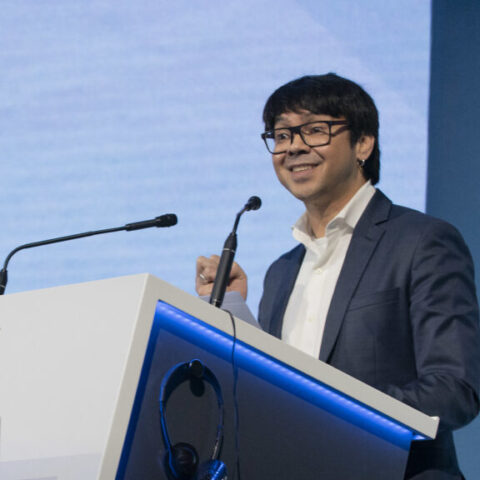
Alfred Moses, Chairman of UN Watch, former U.S. Ambassador to Romania, Special Presidential Envoy for the Cyprus Conflict, and Special Counsel to President Jimmy Carter, delivers the concluding remarks for the 1st Annual Geneva Summit for Human Rights and Democracy – see quotes below, followed by full prepared remarks.

Full remarks

Nazanin Afshin-Jam: Ambassador Alfred H. Moses, who is the chair of UN Watch, a human rights NGO in Geneva. He is a former partner and now senior counsel at the Washington law firm of Covington and Burling. He has served as US Ambassador to Romania, President Clinton’s special emissary for the Cyprus conflict, and is an honorary National President of the American Jewish Committee. Ambassador Moses, thank you.

Ambassador Alfred Moses: Thank you, Madam Chairman, thank all of you for staying so late after such an inspiring, long day. I don’t think, in the annals of history, anything we say here today, it’ll be said in Geneva over the next five days, will enter into the annals of history. What may be remembered by some, in my view, is the lost opportunity. We should not have to be here. It would have been far better, Mr. Ambassador, if France, the European Union, my country, the United States, Canada, Israel, and other like minded countries, they simply said, “No.”

Then we might have really seen something. Not looking for the albinos; there will always be injustice. But looking at the issue, which confronted us here today, and which we’ve known about for months, for years leading up to today. If we had stood together, if we had the courage to say, “No,” we could have turned this around. But we didn’t. My own country didn’t look at the issue until very late within the administration and did not engage. And the European Union looked at it and said, “There’s a future day, let’s pray.” And that simply isn’t good enough.

So what I say to you, and it’s my individual view, certainly not that of my government, I can’t even say it’s that of UN Watch, is that all we remembered from this week, is what we didn’t do and should have done. And had we done so we’d have had a far better result. I wish I could speak with the authenticity of Mohamed Sifaoui, but I can’t. I did not leave my country of origin. I did not take on [the] majority of my co-religionists; perhaps I was not brave enough, perhaps I didn’t have reason to. I lack his authenticity and the authenticity of many of you here today. My convictions are no less real. And my beliefs, no less a commitment on my part.

Let me visit with you a bit of a historical perspective, brief, put to the point. And in saying so, I think I can share with Floyd Abrams and some others here, when I say that the future struggle will not be ours, it will be yours. It is the generation, two below mine or two after mine, that’s going to have to carry on this struggle. We did not win. I hope you will win. Let’s remember it was in the flesh of the Allies’ victory in World War II that human rights was reborn. It was a time of liberation, emotionally and politically. With the defeat of the Axis powers, once again, everything was possible. Even when the Iron Curtain had descended over Europe, in the words of Winston Churchill, “From Stettin in the Baltic to Trieste in the Adriatic, human rights prevailed.” The yearn for freedom continued. The creation of the Human Rights Commission in 1946 expressed that very yearning. The leaders, giants in their days, and persons who remained giants in our memories, were the heroes six decades ago, Eleanor Roosevelt, Rene Cassin, Reinhold Niebuhr. Later Rosa Parks, Martin Luther King, followed by Nelson Mandela, and yes, Aung Bo Chi and Bo Ti. Those who died at Tiananmen square and those who are with us in Geneva and will be with us; the Eli Wiesels, the Bernard-Henri Lévys. Other persons of great distinction, we have heard from and we’ll hear from; Ahmad Batebi, Esther Mujawayo, great heroes, persons who have prevailed, have been repressed, and have survived to lead us.

But in recent decades, the cause of human rights has been hijacked in many places by oppressers who profess support for human rights for others, where it suits their political purposes, but not for their own citizens, whose freedom they fear. There are pervasive human rights abuses in Zimbabwe, Sudan, Tibet, Myanmar, and in much of the Islamic world, whose citizens are denied freedom of religion, gender equality, and the right to express political dissent. These regimes use human rights as a stick with the name, “respect for religion,” to attack others for allowing freedom of expression, while at the same time they deny this to their own citizens.

For too many, dreams of freedom have become nightmares of oppression. This is true in Cambodia and it’s true today in Iran and Libya. Pol Pot is no longer alive to order mass killings in Cambodia. But killing fields exist in both hemispheres, East and West. Tragically, for some, antiracism has become a shield emblazoned with outcries against historic racial injustices. Elsewhere, in an attempt to protect their own oppressive political fiefdoms, in the process, historic crime is placed on the ledger of the West is it that absolves non-western present day human rights abuses by violators who suppress all forms of human rights in their own countries. Make no mistake about it, we’re engaged in a battle that will endure as long as people care about the rights of those who differ in their religious practices or those who deny human rights, in an effort to preserve their own political power.

Our own indifference is an equal or perhaps even greater threat. Silence is not an option. Nor is inaction. We need to reemphasize the universality of human rights, that knows no borders, and is not faith or culture-based, but exists for all humanity. Humanity viewed as a family, without political borders, drawing on almost 4,000 years of human experience, giving meaning to human rights, that incorporates the rights of women not to be mutilated, that respects freedom of conscience and expression, that condemns torture and physical oppression, and bars discrimination based on ethnicity, religion, or gender.

To be heard, we need to speak out. To avail, we need to engage. Let’s go forward — from this convocation, from the inspiring words you’ve heard today — renewed in our commitment, not in the future, to be indifferent to those who oppress others, to be more than vigilant, to have the courage to say, “No,” and to walk away. Only then will we be heard. Only then will we see a change in conduct here in the United Nations. I thank you.

Speakers and Participants

Alfred Moses

Chair of UN Watch, former U.S. Ambassador to Romania, Special Presidential Envoy for the Cyprus Conflict, Special Counsel to President Jimmy Carter

Related

Tibet

Tortured by China with Golog Jigme

Golog Jigme, a Buddhist monk and human rights activist who was jailed and tortured for making the documentary “Leaving Fear Behind”, addresses the 8th Annual Geneva Summit for Human Rights and Democracy – see quotes below, followed by full prepared remarks. On being tortured by China: “Why did they torture me?

Modern Slavery

The Battle to End Slavery with Biram Dah Abeid

Biram Dah Abeid, “the Nelson Mandela of Mauritania,” founder of the Initiative for the Resurgence of the Abolitionist Movement (IRA) and an antislavery campaigner, addresses the 6th Annual Geneva Summit for Human Rights and Democracy – see below for full prepared remarks.   Full Remarks   Biram Dah Abeid: I thank you, dear

Authoritarianism and Dissent: 21st Century Horizons with Ko Bo Kyi

Ko Bo Kyi, former Burmese student activist, political prisoner, and founder of the Assistance Association for Political Prisoners, addresses the 2nd Annual Geneva Summit for Human Rights and Democracy – see below for full prepared remarks.   Full remarks   Ko Bo Kyi: Good afternoon, ladies and gentlemen. Thank you very much for

Disability Rights

The Life of the Disabled in North Korea with Hyosim Maeng

North Korean defector, human rights activist, and advocate for disability rights, Hyosim Maeng, addresses the 16th Annual Geneva Summit for Human Rights and Democracy – see below for her remarks. Full Remarks:  My mission is to raise awareness about the lives of disabled people in North Korea. Over the years,

Human Rights

The Abolitionist Who Won’t Be Silenced with Biram Dah Abeid

Biram Dah Abeid, Mauritanian antislavery campaigner and founder of Mauritania’s Initiative for the Resurgence of the Abolitionist Movement (IRA), receives the Courage Award and addresses the 12th Annual Geneva Summit for Human Rights and Democracy — see quotes below, followed by full prepared remarks. On slavery in Mauritania: “Our parents,

Democracy

Geneva Summit 2017 Courage Award with Mohamed Nasheed

Mohamed Nasheed, former President of the Maldives and Geneva Summit Courage Award winner, addresses the 9th Annual Geneva Summit for Human Rights and Democracy – see quotes below, followed by full prepared remarks. On his abuse by authorities in the Maldives:  “I’ve spent the good half of my adult life in

Victim Testimonies with Jacques Beres

Jacques Beres, a war surgeon who smuggled himself into Homs in 2012 to help the Syrian people, addresses the 4th Annual Geneva Summit for Human Rights and Democracy – see below for full prepared remarks.   Full remarks   Saba Farzan: Hello. Good afternoon ladies and gentlemen. Because we are the last panel

Political Prisoners

Held Hostage In Iran with Mariam Claren

Daughter to German-Iranian women’s rights activist Nahid Taghavi, currently held hostage in Iran, Mariam Claren, speaks at the 14th Annual Geneva Summit for Human Rights and Democracy – see quotes below, followed by full prepared remarks. On leaving Iran: “The last time I stepped foot in Iran, I was 2 years

War Crimes

Surviving the Siege of Aleppo with Waad Al-Kateab

Waad Al-Kateab, Syrian refugee, activist and award-winning filmmaker, addresses the 13th Annual Geneva Summit for Human Rights and Democracy – see quotes below, followed by full prepared remarks. On eruption of 2011 Arab Spring in Syria: “The idea that people would fight back was something I’d always dreamed of, but

Human Rights

Surviving Slave Labor with Il Lim

Il Lim, North Korean defector and former slave laborer, addresses the 7th Annual Geneva Summit for Human Rights and Democracy – see below for full prepared remarks. Full Remarks I would like to tell you about my experience as an overseas worker. 19 years ago, on November 8th, 1996, I went to Kuwait

Tortured by the Libyan Regime with Kristiyana Valcheva

Kristiyana Valcheva, a Bulgarian nurse who was wrongfully accused by the Libyan regime of participating in the poisoning of 400 Libyan children, imprisoned, and tortured, addresses the 1st Annual Geneva Summit for Human Rights and Democracy – see below for full prepared remarks.   Full remarks      

Uyghur Persecution

The Campaign to Stop China’s Destruction of the Uyghurs with Rahima Mahmut

Rahima Mahmut, Uyghur human rights activist, translator, and singer, addressed the 17th Annual Geneva Summit for Human Rights and Democracy on February 18th, 2025. Full Remarks: Good morning, ladies and gentlemen. It is an honor and privilege to be here with you today. In 1989, I was one of thousands

Democracy

Refugee from Burundi’s Regime with Ketty Nivyabandi

Ketty Nivyabandi, human rights defender who was forced to flee her home in Burundi in May 2015 after leading a peaceful protest, addresses the 11th Annual Geneva Summit for Human Rights and Democracy – see quotes below, followed by full prepared remarks. On dire human rights situation in Burundi: “Burundi’s regime

The Situation of Human Rights in China with Ti-Ana Wang

Ti-Anna Wang, a Chinese-Canadian dissident whose father, Wang Bingzhang, is a prisoner of conscience in China, addresses the 3rd Annual Geneva Summit for Human Rights and Democracy – see below for full prepared remarks.   Full remarks

Tibet

Safeguarding Tibetan Culture with Kalden Tsomo

Kalden Tsomo, Tibetan activist and UN Advocacy Officer at the Tibet Bureau Geneva, addresses the 4th Annual Geneva Summit for Human Rights and Democracy – see below for full prepared remarks.   Full remarks   Kalden Tsomo: Good afternoon ladies and gentlemen. Before I proceed, allow me to make a slight correction in

Human Rights

Venezuela: Fighting For Freedom with Tamara Suju

Tamara Suju, Venezuelan lawyer and human rights activist, addresses the 7th Annual Geneva Summit for Human Rights and Democracy – see below for full prepared remarks. Full Remarks Good morning. I’ve been asked to talk about my experience and what I’ve done so that I would end up in the Czech Republic, which

Authoritarianism

North Korea’s Oppression with Timothy Cho

Timothy Cho, North Korean human rights activist and defector who was imprisoned four times in North Korea and China, addressed the U.N. Opening for the 18th Annual Geneva Summit for Human Rights and Democracy on February 17th, 2026. Key Quotes: “Where is justice for the people of North Korea in

Human Rights

The Islamic Republic’s Crackdown on Dissent with Mahan Mehrabi

Mahan Mehrabi, sister of Iranian political prisoner Mahmoud Mehrabi, addressed the 17th Annual Geneva Summit for Human Rights and Democracy on February 18th, 2025. Full Remarks (Translated from Persian): Greetings to all, greetings to the Prince of Iran. Greetings to my people. I would like to thank the Prince of