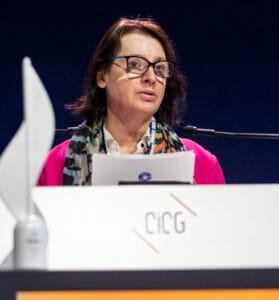
Centa Rek, Senior Legal and Policy Associate at the Human Rights Foundation, addresses the 11th Annual Geneva Summit for Human Rights and Democracy – see quotes below, followed by full prepared remarks.
On authoritarianism in Latin America:
“For over a decade now Latin America in general and more specifically countries like Venezuela, Nicaragua, Bolivia, and Ecuador at some point have experienced the nefarious effects of authoritarianism and the results are disastrous.”
“Today in Venezuela the Maduro regime rules with impunity the fates of millions of Venezuelans by using violence, famine, and death as weapons against its own people.”
“In Nicaragua, the Ortega regime is imprisoning and torturing people like Cristian Fajardo and Amalia Delia Peralta and this is the case for many many Nicaraguans.”
“And Cuba, who has been ruled by the same brutal regime for nearly 60 years, which continues to persecute anyone calling for change.”
Full Remarks
Good morning everyone.
My name is Centa Rek, and I’m a lawyer at the Human Rights Foundation, an NGO based in New York that advocates for freedom and democracy with a focus on closed societies.
Our work focuses on two systems, dictatorships like Venezuela and Cuba where broadly speaking there is a one-party system without free and fair elections, where there is no independence between the powers of the state, no independent media or NGOs, no vibrant civil society, where civil liberties are not respected, and where the government cracks down on dissent in a systematic way.
We also focus on competitive authoritarian regimes or hybrid regimes like Bolivia, and up until very recently, Ecuador, which are countries where democratic institutions are just a façade. Where the opposition faces pervasive harassment and judicial persecution, where elections take place but are neither free nor fair because the electoral playing field is significantly lopsided, and where there is some independent media but critical journalists and outlets are constantly harassed or threatened by lawsuits for reporting on or criticizing the government. And this is the case for anyone who is part of the civil society in these countries.
For over a decade now Latin America in general and more specifically countries like Venezuela, Nicaragua, Bolivia, and Ecuador at some point have experienced the nefarious effects of authoritarianism and the results are disastrous. Today in Venezuela the Maduro regime rules with impunity the fates of millions of Venezuelans by using violence, famine, and death as weapons against its own people.
In Nicaragua, the Ortega regime is imprisoning and torturing people like Cristian Fajardo and Amalia Delia Peralta and this is the case for many many Nicaraguans. This is just a young couple who have been in prison since July last year and whose only crime was to peacefully call for a democratic transition in their country.
And Cuba, who has been ruled by the same brutal regime for nearly 60 years, which continues to persecute anyone calling for change.
Today I am here to introduce you to three remarkable individuals who have fought and continue to fight from their respective platforms to defeat authoritarianism in Latin America.
Our first speaker is Ambassador Diego Arria, a former Assistant General of the United Nations, Venezuelan ambassador to the United Nations, and Chairman of the United Nations Security Council. He’s known for creating the Arria formula, a consultation process that affords members of the Security Council the opportunity to hear individuals in a confidential, informal setting and at the same time circumvent the veto from presidents and permanent members like China and Russia. In 2011 Arria filed a complaint with the International Criminal Court against Hugo Chavez for crimes against humanity. He has advocated against the election of Venezuela, and other authoritarian countries, to the United Nations Human Rights Council. Today Ambassador Arria will talk about the Maduro regime’s crimes against humanity and the Venezuelan people’s longing to live in peace and freedom once again.
Our second speaker is Félix Maradiaga, a Nicaraguan academic, human rights defender, and social entrepreneur, who is currently recognized as one of the main opposition voices against the Ortega regime. Félix is currently the director of the Institute for Strategic Studies and Public Policies, a top think-tank in Latin America, and has previously led civil society organizations in that country. Today Félix is here to share his personal story of political persecution under the current regime and his views on the situation and the future of Nicaragua.
Last but not least we have Juan Carlos Gutierrez, a human rights lawyer and the President of the World Jurists Association’s Human Rights Institute. He’s also a partner at Cremades & Calvo-Sotelo law firm in Madrid. He’s a member of the International Criminal Court’s list of consul. Gutierrez is a defender of prisoners of conscience like Leopoldo Lopez and Venezuelan President Juan Guaido, and several other prominent political prisoners in Venezuela. He serves as counsel to the number of NGOs supporting political prisoners in Bolivia, Cuba, Turkey, and Venezuela. Today Juan Carlos will be presenting the case of Dr. Eduardo Cardet, the leader of the Christian Liberation Movement in Cuba, who is currently under arbitrary detention in that country. He’s also going to talk about Leopoldo Lopez and the current situation of prisoners of conscience in Venezuela.
We are privileged being Latin American to have such brave and dedicated individuals and experts to help us better understand the horrific situation in these countries.
Please welcome Juan Carlos Gutierrez.