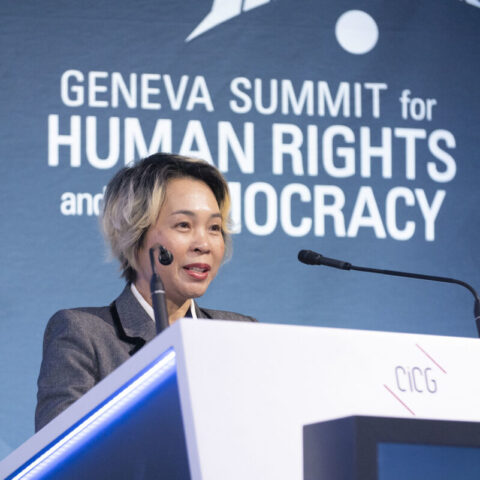
A panel including international lawyer and associate counsel at the International Criminal Court (ICC), Ilana Soskin; a Zimbabwean journalist, human rights advocate, and key opponent of the Mugabe regime, Grace Kwinjeh; prominent Venezuelan journalist and political activist, Miguel Angel Rodriguez; and French-Vietnamese exile journalist who was imprisoned by her government for association with the pro-democracy Viet Tan party, Nguyen Thanh Van, address the 3rd Annual Geneva Summit for Human Rights and Democracy – see below for full prepared remarks.
Full remarks
Ilana Soskin:
Thank you, Grace, for your comments. What’s incredible is that we see that there are people who have had their liberty restricted and have been attacked. We see them fighting with great fervor, with great enthusiasm. And we’d like to thank you all for fighting and we encourage you to continue and to spread this enthusiasm.
I’d like to read you something from a Chinese paper to justify a weight of repression, saying that, “Since the end of the year, of last year, certain countries in the Middle East and other countries have had a number of upheavals. And we all are aware that happiness is stability and chaos is disaster. We should be aware of the fact that there will always be some people who will complain about problems that exist and incite people to disorder.” Now, in your countries, have there been official declarations like this in the press, asking you not to react and not to listen to the revolutionaries in your countries? You have other examples of this type, where we see the country governments are afraid of contamination, of this fervor spreading. Who would like to answer this question?
Nguyen Tanh Van:
In Vietnam, now, young people above all, and in different organizations, there has been a cause to protest. The police are in front of their doors and they can no longer go out. And every day, they’re trying to prevent them from going to demonstrations or protests.
Miguel Angel Rodriguez:
In the case of Venezuela, in the last 12 years, 150,000 people have been murdered. And the government says that that’s a “perception of insecurity.” And behind this perception of insecurity, there is basically — this has been called by the press — the press has worked to destabilize society and the press is responsible for this and Chavez is supported by 80% of the people and that the press must be controlled.
Ilana Soskin:
And in your view, what are the greatest challenges to the freedom of expression and education in your country? And information in your country, rather?
Grace Kwinjeh:
Broadcasting especially, we still have a government monopoly and the issue of hate speech is still going on. So you’ll find that right now, there is a concerted effort to demonize leaders of the civic and political opposition. You have senior members of the ruling Zanu PF party — I was trying to find the quotation here right now — of one of the former Ambassador[s] for South Africa who is in the top hierarchy of Zanu PF, actually saying something to the effect that, “we will kill them.” It’s the kind of language that you have by senior government officials without – who do so with impunity. Then you have the state controlled papers, of course they on a daily basis are dedicated to publishing hate speech, hate articles that are meant to demonize the opposition.
Ilana Soskin:
Would you like to add anything?
Nguyen Tanh Van:
Now in Vietnam, we’re trying to overcome our difficulties now, not to be afraid. And to use the internet as much as possible and we’re calling upon our people to use the internet, to disseminate information, news about our struggle, and not to throw in the towel when we’re faced with all this repression.
Ilana Soskin:
Thank you. We’d like to use the last few minutes to see if we have any questions in the hall. I don’t know if you’ve written questions on pieces of paper, if you’ve given these papers to the staff. Are there any questions?
So I’ll take questions from the floor. Sir, would you please introduce yourself? Speak and make it brief. Please. These are questions. Just one minute, please. These are not statements. Just questions. Thank you.
Question #1:
I work for the Institute for Jewish Research in Canada. I’d like to address one point to Miguel. As you know, in just about one block from Miami airport, there’s a satellite internet store that sells about 1,000 dishes every month to Venezuelans — either expatriates or citizens — for internet access. So using proxy servers in Venezuela, there’s a large community still able to access non-government-blocked firewalls through Venezuela.
And to Grace, my question here is do you think that we can see a Shona inspired – I don’t want to use the word revolution – but certainly a Shona inspired uprising of the people, similar to what we’ve seen in the Middle East, based on Twitter and Google, given the fact that today with proxy servers, there is Internet access available for all citizens, provided they can get access to the servers. What are the chances? And I address the same question to Miguel as well. Thank you.
Miguel Angel Rodriguez:
When in 2007, they closed down Radio Caracas, the channel, there was a 30% coverage of the population and the population changed to satellite, and satellite television. So paid television had to go up to 70% to be able to program freely and the government tracked indirectly. And they intervened in private property — because this is private property — to pull out a potential enemy.
And I’d like to inform you that we have an exchange rate system. That is, the government detains dollars and approves of them or not. And if there are imports, it decides whether or not it is necessary to give this product to Venezuelans. And I know, in small quantities certain products have been brought in, but I am sure that when [Chavez] has greater control over [the] internet and media, of social networks, these will no longer be imported massively. Because it will, not only according to Chavez, be unnecessary, but it will be a potential danger.
Grace Kwinjeh:
I’m not sure. There are many dynamics at play right now and one of the key ones is that you find that there’s a lot of internet access in Zimbabwe and there’s a lot of activity. You go to chat rooms, you go to Facebook, you go to Twitter, you find that Zimbabweans are really engaged in terms of what is happening politically in the country. You feel the anger, you feel the anxiety. But I think what is missing now is some kind of rallying call in terms of the issue that galvanizes, that consolidates that anger into something that can produce something. It’s Zimbabwe; you know [it’s] made up not just of Shona, but we are different ethnic groups. And if there’s anything that the MDC has managed to do over the years, is to get everybody, irregardless of their ethnic grouping, to be mobilized around different issues.
So what is happening right now? I think there is an indirect mobilization of the people by the state itself. Because it’s mobilizing the people, the more that they are persecuting, the more the anger is rising. The more you go on Facebook and on Twitter, I think that they are really creating once again, a solid foundation against themselves of people.
What are the issues that are going to unite Zimbabweans? Perhaps the issue of violence, because Zimbabweans, by their nature, are not a violent people. They don’t like violence, they don’t like violence in communities in the rural areas or in the cities.
And then still on Facebook, we’ve had one arrest a week ago I think, of somebody who was responding to a post by somebody on Facebook. But anyway, he was arrested. And I think he’s being charged with one of these dubious charges that the state is using against activists. So again, the post-Egyptian moment means also the dictatorship knows the avenues that work for them. So you are not going to replicate, perhaps, Egypt in Zimbabwe, because the enemies are aware of what happened in Tunisia, what the methods that the people used for mobilization, and so on. But – it seems contradictory – but on the other hand, really, you feel that the state is organizing the people against itself.
Ilana Soskin:
Any other questions? Madame, would you like to introduce yourself? We can’t hear you. Please, turn on your microphone.
Question #2:
Hi, I’m Dina Cooper. I’m a political science graduate student from New York and I was wondering, much has been mentioned about elections, particularly with regards to Zimbabwe, but as we saw with Iran and Gaza, elections [do] not guarantee democracy. Is there any direct education, being taught to people, citizens, about longer lasting democratic values beyond elections? Thank you.
Grace Kwinjeh:
One of the most wonderful things about Zimbabwe is that we’ve had a society, we’ve had a country with very strong civic organizations. So in terms of the capacity for voter education — you’re asking about voter education — in terms of the capacity to actually reach out to people, the capacity is there; it is enormous. Actually, so many of us are here in the diaspora, but in terms of the roadmap for elections, voter education has to be there, because the fear that is being instilled in the people, you will need people to go out on the ground, in the communities, explaining how they should vote, and so on. So I have confidence in the civic organizations in Zimbabwe.
We are a country that is coming from somewhere and that is what makes you sad, because we’re not coming from being a collapsed state. We’ve been, I think, the richest, one of the richest, progressive countries on the African continent. The best health and education systems. We really prided ourselves because we were [the] jewel of Africa. So what is happening is a man-made disaster, which I believe that somebody has to tell this man that this disaster has to end now. And all these things will fall into place. And I think that’s the first – the roadmap for elections has to cover all that.
I mean, you’re also talking of healing. These are people – I’m blessed to be here. I have gone for trauma counseling, I have gone through and gone through so many processes to help me to yield, to help me to debrief and so on. But you have a nation that has been under siege over the past 10 years again and again and again. So where do you put in the healing efforts? I know, under the government of national unity, a lot has been happening in terms of reconciling communities and bringing them back together again. So the capacity by Zimbabweans to actually carry out an election that each and every Zimbabwean will be accorded the right information to be able to vote correctly, it is there. Our issue is not even about capacity, but the issue has to do with a man-made disaster.
Ilana Soskin:
Thank you. The last question now. I see your hand’s been up for a while, sir. We can’t hear you. Please, turn on your microphone.
Question #3:
Thank you for giving me the floor. I’d like to take advantage of this moment to thank Mr. Rodriguez, Mme. Kwinjeh, and Mme. Tanh Van for her presentation. I would also like to briefly comment on an important point in my eyes, that is prisoners who are accused of rebellion who are still imprisoned, or work camps in Vietnam. I’d like to talk to you about Mr. Nguyen Binh Thanh and his family and Mr. Nguyen Van Ly.
Nguyen Binh Thanh is a Democrat who was judged on the 30th of March, 2007, for political activities that were peaceful. He was accused of disseminating propaganda against the state, this infamous “Law 88,” and sentenced to five years of prison. His children were aggressed brutally. But the government has not stopped there, they’re harassing their children as well. And at the 22nd appeal in March, the father of Nguyen Van Ly said his two daughters work in the accounting department of a company and the [inaudible] have forced them to leave. And as the police have been throwing stones on their windows and have aggressed them in the street and in their home, and now, they have put them on the ground and undressed them. So you see how women are being treated in Vietnam. This is a dictatorial regime. They undressed the other daughters of Mr. Binh Thanh four times and this is Mr. Binh Thanh’s situation as well as that of his daughters.
Also, the progressive party in Vietnam is a subject I’d like to bring up. Mr. Lang Nguyen Phan was sentenced to six years of prison in March, at the same time as Mr. Binh Tanh, because he was accused of propaganda against the state. But the communist power imprisoned him, actually, to gag him, so that he wouldn’t ask for greater freedom in Vietnam and because he denounced anti-constitutional measures in Vietnam against the law of the country.
Ilana Soskin:
Thank you for this additional information. We would like to remind you that you can ask the panelists any questions that you may have and I would like to thank all the speakers and all those who have raised questions and the quality of their comments. Thank you.